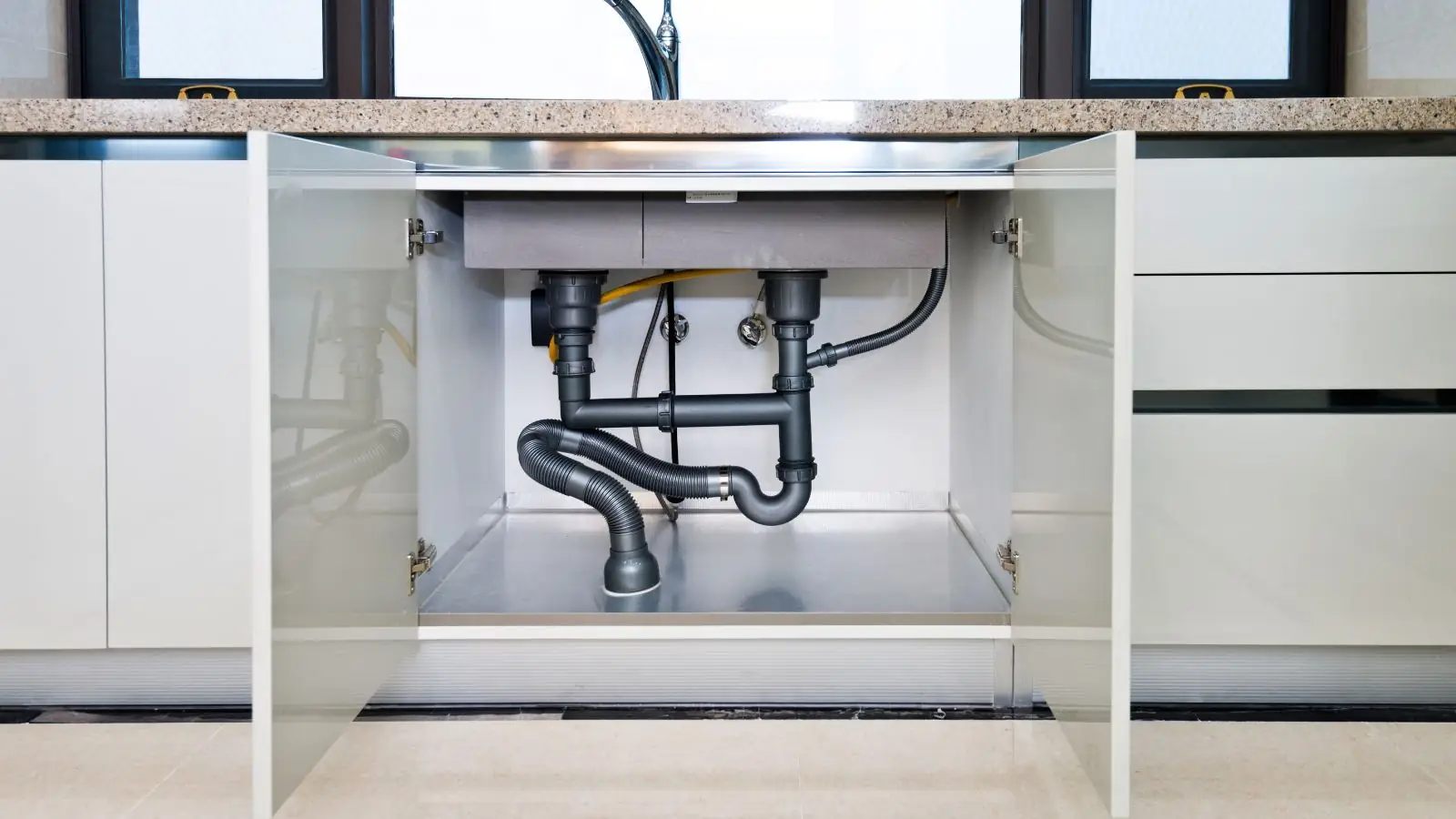
Why a kitchen holds water longer than other rooms
A kitchen packs more water-fed parts into one small room than any other space in a home. The sink, dishwasher, faucet, filter and sometimes an ice maker line all run through the same cabinet bases and the same patch of floor. A drip in one of them can travel a long way before anyone sees it.
The room itself is built to trap that water. Cabinet boxes sit on the subfloor with a toe-kick tucked underneath, and the cabinet backs press against the wall. Water slips under that base, spreads across the subfloor and soaks into the wall cavity behind the boxes. The surface can look fine while the cabinet bottoms stay wet for days.
What you see in a wet kitchen and what it means
| What you see | What it usually means | First move |
|---|---|---|
| Cabinet base swollen, flaking or soft at the bottom edge | Particleboard has absorbed water from a leak at the sink or from the floor | Empty the cabinet, keep the doors open and call before the base crumbles |
| Toe-kick panel bowed or stained | Water has pooled under the cabinet run and wicked up the face | Photograph it, then remove the panel only if it comes off without force |
| Floor tile or vinyl lifting near the sink or dishwasher | Moisture has reached the underlayment or subfloor below | Stay off the area and request moisture readings under the covering |
| Cracked grout or loose backsplash tile | Water has gotten behind the tile into the wall board | Avoid pressing on it and ask for a wall check before regrouting |
| Musty smell inside the sink cabinet | A slow seep has been feeding damp material for some time | Take everything out and look for dark staining on the back panel |
| Countertop edge lifting or a seam opening up | Water has swollen the substrate under the laminate or wood top | Do not pry it apart, and have the substrate checked |
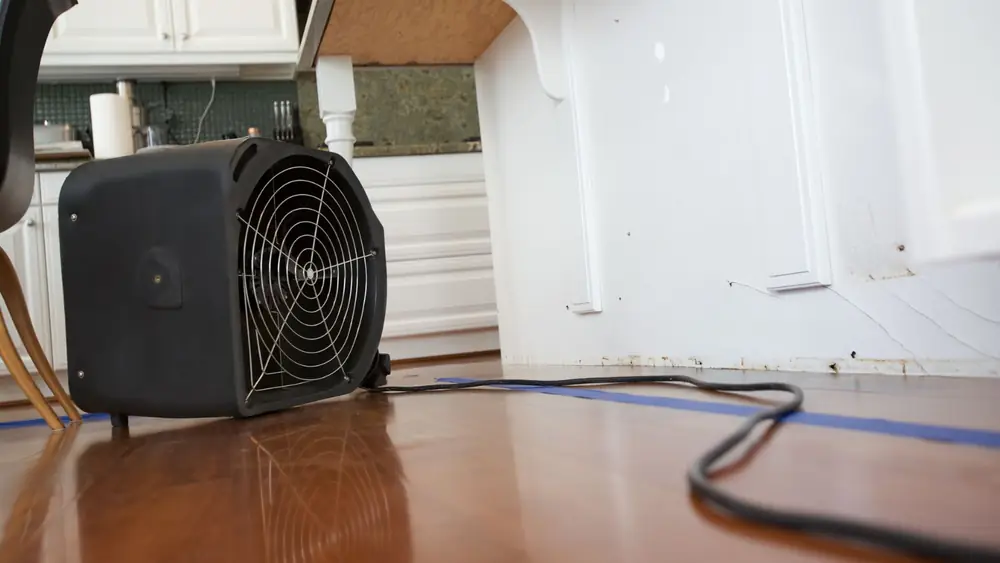
Safety steps for the first hour in a wet kitchen
- Close the shutoff valve under the sink or the home's main water valve. A plumber handles any part that will not hold.
- Stay off wet floors near outlets, the range and the refrigerator, because kitchens have many plugged-in machines at floor height.
- Switch off the breaker only if the panel is dry and you can reach it standing on a dry surface. If water is near the panel, call Snohomish County PUD first.
- If you smell gas from the range, go outside, call 911, then call Puget Sound Energy. Do not flip switches on the way out.
- Do not run the dishwasher or garbage disposal until the source is found.
- Lift food, small appliances and cabinet contents onto dry counters, then call our dispatch line for the wet floor and cabinets.
Plumbing repair is not our work. A licensed plumber fixes the supply line, drain or faucet, and we dry and clean the room around that repair. Dispatch can tell you which job to schedule first so nobody blocks the other.
Cabinets still wet underneath?
Call and describe the sink, dishwasher and floor.
How we dry the cabinets, floor and walls
Crews begin with a moisture meter and a thermal camera. The meter gives numbers for the cabinet bases, wall board and subfloor, and the camera shows cool, wet zones that hide behind finishes. Together they show whether the water stopped at the toe-kick or traveled under the whole run.
Extraction units remove standing water from the floor. Air movers then push dry air across surfaces, while LGR dehumidifiers pull moisture out of the room so it cannot settle into wood and board. Behind fixed cabinets, small ports can be opened in the toe-kick or back panel, and drying mats or ducted air can move dry air through the hidden space without tearing out good cabinetry.
Some pieces are not worth saving. Swollen particleboard rarely returns to its original shape, and soaked insulation in a wall behind the sink is often removed. Solid wood and plywood parts have a better chance of drying in place. We follow the ANSI/IICRC S500 standard for water damage, and you can ask any company whether its crews do the same.
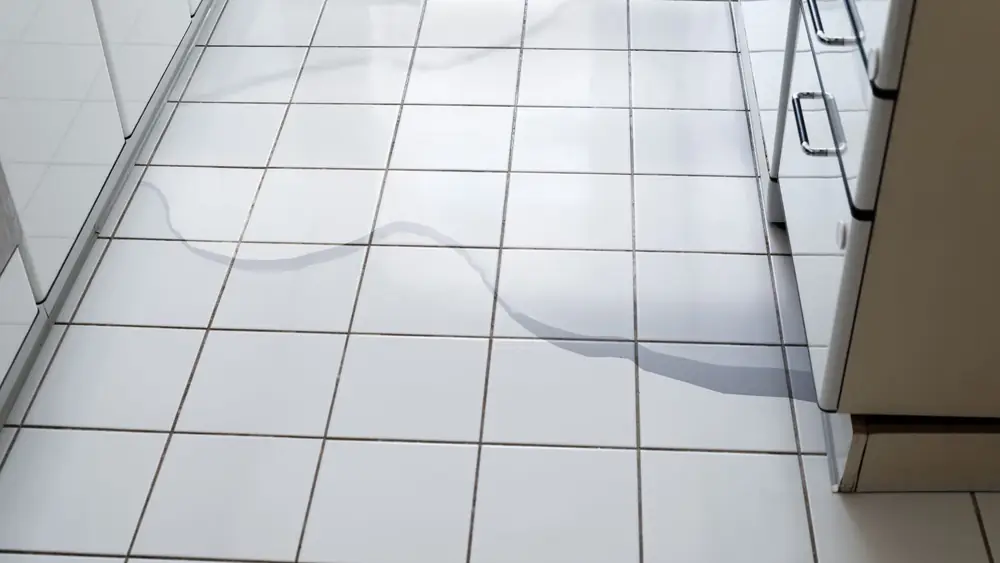
Tile, countertops and the layers underneath
Tile and stone shed water well, but the layers below them do not. Mortar bed, backer board and subfloor can hold moisture long after the surface dries. A kitchen floor may need a few tiles lifted so the layer beneath can be read and dried.
Countertops depend on the material. Stone and solid surface tops usually survive, and the support under them gets the attention. Laminate over particleboard can swell at seams and edges, and those tops often cannot be saved. The sink and cooktop cutouts are the first places to check.
Dishwasher and sink lines as the starting point
Dishwasher inlet hoses, sink supply lines and drain connections are the usual sources in a kitchen. The water they release behaves differently. Clean supply water is Category 1. Dishwasher discharge is Category 2 under the IICRC categories, which carries soil and food residue and calls for more careful cleanup of porous materials.
This page is about the room and what it is made of. If the appliance itself is the problem, our guide on appliance leak water damage covers failure patterns for washers, dishwashers and ice makers.
Drying deadlines and where the rebuild begins
EPA guidance says to dry water-damaged areas and items within 24 to 48 hours to prevent mold. In a kitchen the clock matters because the wet material is hidden under cabinets. Our water mitigation page explains the first 24 to 72 hours, from shut-off to drying setup.
Once readings return to normal, the rebuild can start. Our water damage repair page covers drywall, flooring, paint and cabinet work after the room is dry. If the rebuild changes where the sink or fixtures sit, the City of Mukilteo's permit page says a plumbing permit is needed any time plumbing or fixtures are moved or significantly altered. Ask the city Permit Center before your contractor plans a new layout, since a permit changes the schedule.
What drives the cost of a kitchen job
- How long the cabinet bases and subfloor stayed wet.
- Whether the water was clean supply water or Category 2 discharge.
- The cabinet material, whether particleboard, plywood or solid wood.
- The flooring and the layers under it, including tile and underlayment.
- How far the water reached into the wall behind the cabinets.
- The number of drying days and the equipment the room needs.
Scope and price explained before work starts means you see the plan before equipment is set up. We describe what the meters show instead of guessing over the phone.
Insurance and kitchen water damage
The Washington Insurance Commissioner says a policy usually covers sudden and accidental leaks, while gradual seepage is another matter. The same guidance warns that your coverage can suffer if you delay repairs. In a kitchen, that means getting the wet cabinet bases dried quickly and reporting the loss to your insurer.
Photograph the sink cabinet, the floor and any damaged panels before anything is moved. Keep the failed hose or fitting if the plumber removes it. Check your policy and ask your insurer what applies, because no one can promise an outcome from the phone.
Mistakes to avoid in a wet kitchen
- Putting a new countertop or flooring over cabinets that are still damp.
- Caulking the sink edge while the cabinet underneath is wet.
- Waiting for the cabinets to dry on their own with the doors closed.
- Running a space heater near wet particleboard or cords.
- Tearing out the toe-kick and bases before photos are taken.
- Mixing cleaning products to fight a musty smell.
Kitchens in Lynnwood and Edmonds homes face the same hidden-moisture problems. Our Lynnwood and Edmonds pages explain how nearby coverage works if your address sits outside Mukilteo.
Frequently asked questions
Yes. Dispatch runs 24/7 and a same-day response is offered when crews are available. Call (425) 592-3399, close the shutoff valve under the sink if you can reach it safely, and describe which cabinets and floor are wet.
Often, yes, if the water was caught early and the cabinets are solid wood or plywood. Particleboard bases that have swollen usually have to be replaced. Moisture readings decide which cabinets stay and which go.
Not always. Crews can open small ports in the toe-kick or back panel and push dry air through the hidden space. Cabinets come off only when readings show the wall or subfloor will not dry any other way.
Typically a few days, though it depends on the materials and conditions. Tile over a wet subfloor and thick cabinet bases take longer than a thin surface wetting. Daily meter readings tell us when the room is ready for repairs.
It depends on the work. The City of Mukilteo's permit page says a plumbing permit is needed any time plumbing or fixtures are moved or significantly altered. Ask the city Permit Center how the rule applies to your plan, especially if the sink is moving.
We do not repair plumbing. A licensed plumber fixes the supply line or drain. We dry and clean the room, then rebuild finishes such as drywall, flooring, paint and cabinets as part of the repair phase.
Still have a question? Call (425) 592-3399, any hour.