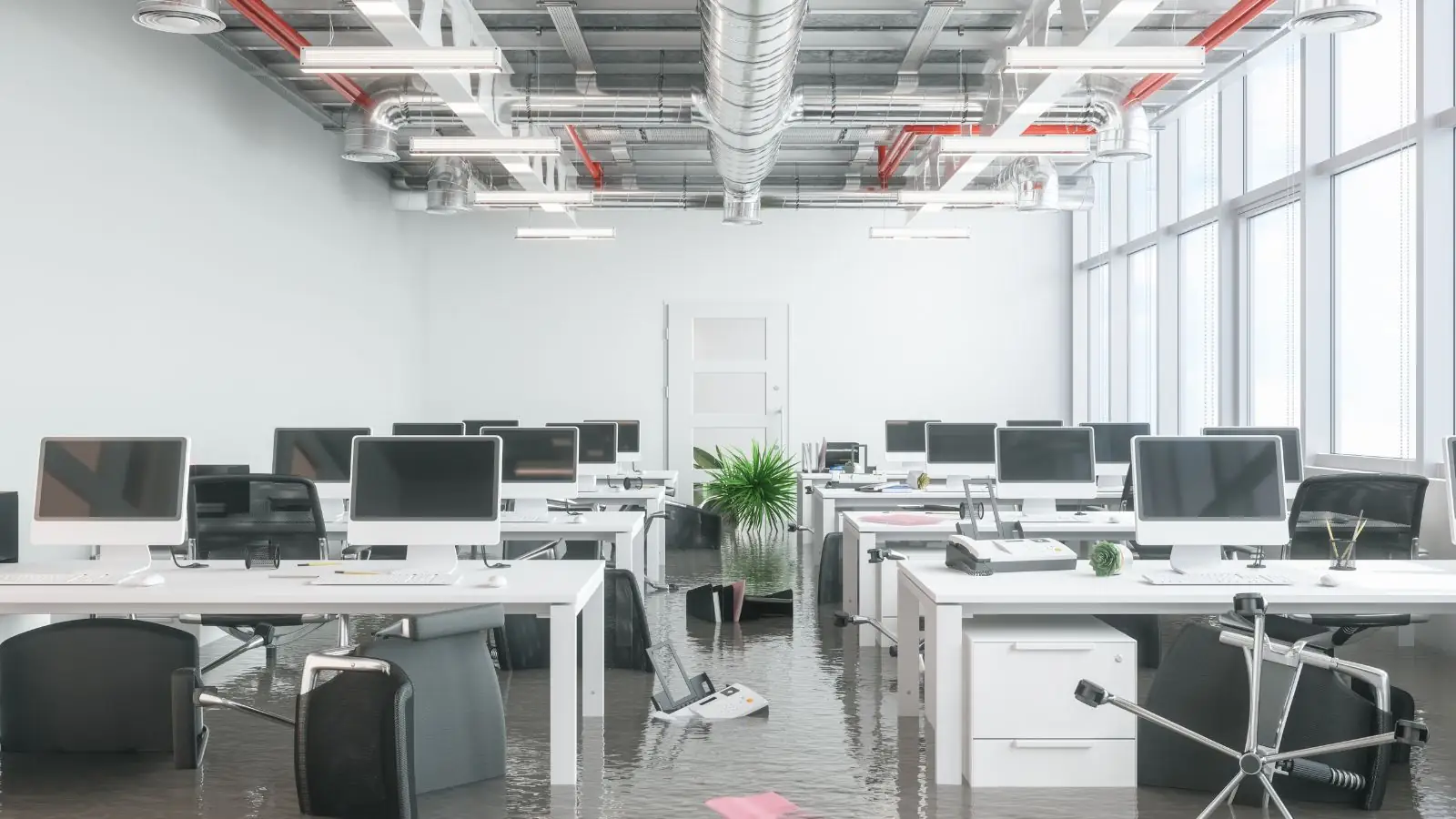
Why a wet commercial space behaves differently from a wet house
A commercial loss usually involves more than one party. A pipe fails in a storeroom, and the water spreads under a wall into the next suite, or drips through a ceiling into a shared hallway. Mukilteo's mild, rainy winters add roof drains, rooftop units and parking-lot runoff to the usual list of sources.
The building itself is often built differently from a home. Flat roofs, slab floors, suspended ceiling tiles, steel studs and glued flooring all absorb and release water at their own pace. We dry, extract, clean and rebuild, and a plumber or roofer fixes whatever let the water in.
Signs in a building and what they usually point to
| What you see | What it usually means | First move |
|---|---|---|
| Stained or sagging ceiling tiles | Water above the ceiling from a roof drain, supply line or rooftop unit | Keep people out from under the tiles and call the line |
| Wet carpet near a shared wall | Water traveling from the next suite or from a failed line inside the wall | Tell the property manager and stop foot traffic on the area |
| Standing water on a shop floor | A drain backup, a burst line or water pushed in from outside | Cut power to the area only if the panel is dry and reachable |
| Bubbling paint or loose baseboard | Moisture inside the wall cavity, possibly for days | Photograph it and call so the wall can be mapped |
| Musty smell in a closed storeroom | A hidden leak or a slow condensation problem | Find the source first, then call about drying |
| Floor tiles lifting or glue letting go | Water under the floor covering | Keep carts and furniture off the area |
Safety steps before anyone returns to the space
- Shut off the water at the nearest valve or the building main, if you can reach it without stepping into standing water.
- If water touches outlets, panels or floor-mounted wiring, stay out. Cut power only if the panel is dry and you can reach it without crossing wet floor.
- Smell gas or see sparks? Leave, then call 911 and the gas utility before you call the restoration line.
- Call the electric utility about downed or exposed service equipment, and the water district about a main that will not shut off.
- Do not run vacuums, plug in space heaters or use ladders near wet ceiling tiles.
- If the water looks gray or smells like sewage, treat it as contaminated and keep everyone out until the crew arrives.
Business space with standing water?
The sooner extraction starts, the less the floor, walls and ceiling absorb.
How the crew dries a suite or shop floor
Work starts with a walk-through and moisture readings. A moisture meter checks drywall, wood and concrete at set points, and a thermal camera shows cool, wet areas behind finished surfaces. Those readings become a drying map, so the crew knows where the water went and where it did not.
Extraction units pull standing water and wet carpet pad first, because every hour of soaking pushes moisture deeper into slabs and wall bases. Air movers then create steady airflow across wet surfaces. LGR dehumidifiers pull the released moisture out of the air so it does not settle in cooler corners.
Where water was dirty, air scrubbers with HEPA filtration run during demolition and cleaning. Ceiling tiles, insulation and wallboard that stayed wet are often removed rather than dried, though that depends on the material and the water category. You can ask any company whether its crews work to ANSI/IICRC S500, the published standard for water damage restoration.
Keeping dry parts of the building open
A wet loss does not always mean closing the whole property. The crew can set up containment with plastic sheeting and zip walls, so dust and humidity stay inside the affected zone. Air movers and dehumidifiers are placed to dry the wet area without pushing damp air into the rooms next door.
Whether part of the building stays open depends on the water category, the electrical situation and what the property manager decides. Tell the dispatcher which suites, hallways and exits are still in use, and the plan can be built around them. After-hours calls are welcome, and the line takes calls at night and on weekends.
What moves the cost of a commercial loss
- Square footage of wet floor, walls and ceiling, and how high the water climbed
- Water category: clean supply water, discharge, or sewage and storm runoff
- Materials: slab and tile dry differently than carpet, wallboard and acoustic ceilings
- How long the water sat before extraction began
- Access: stairs, loading doors, locked suites and the need to work around open businesses
- Amount of demolition and whether a rebuild follows, covered by water damage repair
Scope and price explained before work starts, so the property manager or owner can decide with the full picture. Two losses of the same size can differ a lot once the materials and the water category are known.
Registration, permits and flood maps for a Mukilteo address
Washington requires all construction contractors to register with the Department of Labor and Industries, according to L&I. Since repair and rebuild work falls under that rule, ask any contractor for its L&I registration before you sign a repair scope. Licensed and insured crews will have it ready.
The City of Mukilteo's permit page says building permit applications go through its online Permit Portal, and building and fire inspections must be requested by 3 pm the day before. If a rebuild reaches walls, fire-rated assemblies or plumbing, ask the city building department what applies to your address. Plan the schedule around that deadline.
FEMA's Flood Map Service Center is the official public source for flood hazard information and has an address search. Check the map for your building if water came from outside, because that answer changes the insurance conversation. Outside water is also the case where our flood damage restoration page applies.
Read both the policy and the lease
Commercial policies and leases differ more than home policies do, and nobody can say in advance what yours covers. In general, sudden and accidental water damage is often covered, while gradual leaks and neglect often are not. Flood is usually excluded and needs its own coverage, so check your policy.
The lease may say who insures the walls, floors and improvements, and who pays for the contents. A landlord, property manager and occupant can each hold a different policy for the same room. Ask your insurer before discarding anything, photograph the damage, and keep small samples of removed material if the adjuster may want them.
Mistakes that make a commercial loss bigger
- Waiting for a meeting or a quote while wet carpet and tile sit
- Turning the heat up to dry a wall, which can push moisture deeper
- Reopening a wet suite before the readings come back dry
- Tossing damaged items before photos are taken
- Sealing wet baseboards with paint or new flooring
- Assuming a neighbor's suite is unaffected without checking shared walls
Nearby buildings and shared walls
The same dispatch line serves nearby towns, including Everett and Lynnwood. The process is the same there, and shared walls and utility rooms are checked first.
For the first 24 to 72 hours, the work is described in our water mitigation service. If you want the broader picture of how drying, cleanup and rebuild fit together, the services index lays out each step. For a loss in progress, call (425) 592-3399.
Frequently asked questions
Yes. The line takes calls at night and on weekends, and same-day response is offered when available. Describe the space, the water source and who is in the building.
Often, yes. Containment and careful equipment placement can separate the wet zone from dry areas. It depends on the water category, power and what the building owner decides.
Tell the property manager or landlord, and read your lease for notice rules. If several suites share a wall or ceiling, the neighbors should know too.
It depends on your policy and the cause. Sudden and accidental water damage is often covered, and gradual leaks often are not. Ask your insurer, and expect flood to need separate coverage.
Ask for its L&I registration, since Washington requires all construction contractors to register. Also ask for proof of insurance and whether its crews work to ANSI/IICRC S500.
It can. The City of Mukilteo handles building permits through its online Permit Portal, and inspections are requested by 3 pm the day before. Ask the city building department what applies to your work.
Still have a question? Call (425) 592-3399, any hour.